- The Neuron
- Posts
- 😺 🎙️ Watch: WTF is a "Reasoning Energy-Based Model"?! w/ Eve Bodnia of Logical Intelligence
😺 🎙️ Watch: WTF is a "Reasoning Energy-Based Model"?! w/ Eve Bodnia of Logical Intelligence
Yann LeCun backed this AI startup... tune in to find out why

Matthew Robinson
February 10, 2026
Welcome, humans.
Every AI application you've ever used, be it ChatGPT, Claude, Gemini, or xAI works the same way: it predicts the next word. Over and over, one word at a time.
Today’s AI are shockingly good at this process. But here's the thing: predicting language is not the same thing as reasoning (though Maggie Vale begs to differ).
That's the argument Eve Bodnia makes—and she's got the credentials to back it up. She's a physicist with a PhD in quantum information, 22 published papers on dark matter, and her thesis advisor won the 2025 Nobel Prize in Physics.
She quit academia while eight months pregnant to build Logical Intelligence, a company that just built what they're calling the world's first energy-based reasoning model.
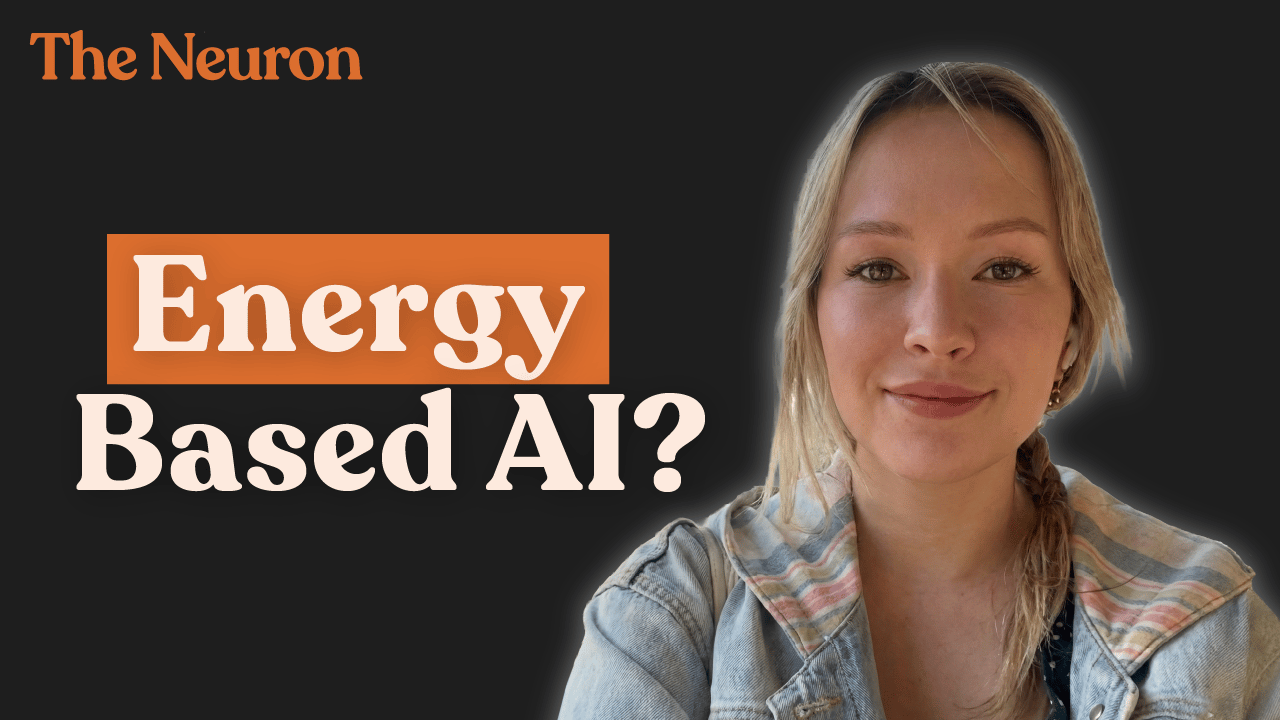
In our latest podcast episode, we talk to Eve about what she built, how energy models work, and exploring the idea of a reasoning energy model and how it could apply to everything from robots to maybe even the human brain.

Click the image above to watch on YouTube!
Here's what blew our minds:
(8:01) Why every AI you use hallucinates—and why it's not a bug, it's the mechanism. Eve breaks down why predicting the next word means guessing is built into the architecture itself.
(13:00) How Kona reasons without language—and why that's the breakthrough. Energy-based models have existed for decades, but Eve's team built the first one that can actually reason. Instead of tokens, Kona maps data into an abstract energy landscape and evaluates all possible scenarios at once—like seeing a maze from above instead of wandering through it blind.
(18:58) The self-correction trick LLMs can't do. Eve explains how perturbation theory (a physics concept) lets Kona detect when its "landscape" drifts off course and pull itself back—no retraining needed.
(21:16) 96% vs. 2%: The Sudoku test that exposes LLM reasoning. Why constraint satisfaction problems break language models, and why Kona crushes them in milliseconds.
(22:15) A 200M parameter model on a single cheap GPU. Eve's model runs on a fraction of the hardware that frontier LLMs need—inspired by the fact that your brain runs on less than 20 watts.
(31:10) Robotics, energy grids, and trading—without needing language at all. Why some of the most important AI use cases don't need a single word of text.
(40:00) Phase transitions: the moment the EBM "takes over" from the language model. Eve describes a physics phenomenon where Kona starts dominating the hybrid system—and why that could mean dramatically fewer GPUs.
(14:52) Her definition of AGI—and why she thinks we keep moving the goalposts. “Ten years ago, if people knew how AI performs right now, they would also call it AGI.”
On that last point, Nature agrees. A group of researchers across philosophy, machine learning, linguistics, and cognitive science just published a paper arguing that by any reasonable standard—including Turing's own—AGI has already arrived.
Their core argument: theories that keep predicting AI will fail “just beyond current achievements” aren't compelling science, they're “a dogmatic commitment to perpetual skepticism.”
In other words, we keep moving the goalposts because admitting the goal was scored is scarier than pretending the game is still going.
That said, if we don’t have AGI today, what Eve has built with Kona and her reasoning energy-based model is probably the closest thing to it we’ve learned about so far.
Why watch this? Because this might be the clearest explanation you'll hear of why language models can't actually reason—and what a credible alternative looks like. If you've ever wondered why ChatGPT confidently gives you a wrong answer, this episode will make it click.
Watch and/or Listen now: YouTube | Spotify | Apple Podcasts
Keep scrolling for more about how energy models work, info about this week’s livestream on Agent 365, additional resources to learn more about Logical Intellignece, and four other recent interviews we think you’ll love.

🔴 LATER THIS WEEK (Thursday, February 12) AI Agents are Here… Now What?
This week on Neuron Live, we're joined by Bryan Goode, Corporate Vice President of Business Applications Marketing at Microsoft, to talk about Microsoft Agent 365—the new control plane for AI agents.

Click the image, then on YouTube, select “Notify Me” to get notified when we go live
Agent 365 is Microsoft's answer to a question every company is about to face: how do you actually deploy, manage, and secure AI agents at scale? It's a registry, an access control layer, and a security system for your entire fleet of AI agents—whether you built them in Copilot or brought them from elsewhere.
Bryan will walk through the process of building an agent in Copilot Studio, then give a guided demo of the Agent 365 interface—navigating the user dashboard, showcasing the workspace, and demonstrating how these tools are deployed and monitored at scale. From the foundational steps of agent creation to the complexities of lifecycle management, this is an expert-led look at how Microsoft sees work evolving with agents.
If you're a Copilot user, tired of repetitive work, and have been wanting to build your first AI agent but didn't know where to start, this is the one to watch live.
Tune in Thursday, February 12 at 11:30AM PT / 1:30PM CT / 2:30PM ET and ask your questions live on your favorite platform: YouTube | LinkedIn | X

So how does an "energy-based model" actually work?
So, Energy-based models themselves aren't new—the concept has been around for decades. But nobody had figured out how to make one reason.
Previous EBMs were used for things like image recognition (remember JEPA?). Eve and her team cracked the reasoning piece by introducing latent space variables (think: the AI equivalent of your brain's ability to hold a problem in the back of your mind while working through it) and a novel navigation algorithm that came from her quantum physics PhD work.
The result is Kona—a model that doesn't predict the next word. It doesn't use tokens at all. Instead, it maps every possible answer onto an “energy landscape”, like a topographic map where valleys are correct answers and peaks are wrong ones, and navigates straight to the lowest valley. No guessing. No hallucinating.
And Yann LeCun, a Turing Award winner, just signed on as the founding chair of their Technical Research Board.
How good is it? In a head-to-head Sudoku test, Kona solved 96.2% of puzzles in an average of 313 milliseconds.
GPT-5.2, Claude Opus, Gemini, and DeepSeek? Together, they managed a 2% solve rate, taking up to 90 seconds per attempt. Oh, and the LLMs' total API bill for the demo was ~$11,000. Kona's? Four dollars.
We had some follow-up questions for Eve after recording, and her answers are worth sharing because they make the whole picture clearer.
The short version: In the episode, Even mentions energy models run on what’s called a Lagrangian—it's a physics equation that describes the total energy state of a system. Physicists use it to find the point where energy is minimized, which tells you how a system naturally behaves (a ball rolling downhill, a planet orbiting a star—nature always finds the lowest energy state).
Kona works on the same principle. Given a problem, it creates an "energy landscape" where every possible answer has an energy score.
Low energy = the answer satisfies all the constraints.
High energy = something's broken.
Instead of guessing word by word like an LLM, Kona finds the valleys—the states where everything is consistent—and goes directly there.
That's why it's so fast and so accurate.
How do you train it? Here's what surprised us: Kona's training is actually similar to LLM pre-training. No reinforcement learning needed. Where LLMs need expensive RL-based post-training to learn reasoning (and even then, it's limited), Kona replaces that step with “RL-free reasoning fine-tuning.”
The model reverse-engineers the reasoning process behind training data and learns to score reasoning correctness directly. This avoids the well-known bottlenecks of RL—the need for a deterministic verifier, limited discovery of new reasoning strategies, and distribution collapse.
How does it talk to language models? In the hybrid system, the energy-based reasoning model is integrated directly into an LLM transformer. During post-training, the LLM part is fine-tuned to faithfully translate Kona's reasoning back into language.
Think of it like this: Kona does the thinking, the LLM does the talking. And their formal verification agent, Aleph, orchestrates calls between Kona, LLMs, and verification tools like Lean 4 (a mathematical proof language) to produce machine-checkable proofs that code behaves correctly across every execution path.
P.S. Eve casually dropped one of the best lines of the interview: “Maybe we are the AGI we're looking for, and we're just trying to create a version of ourselves.” Hard to argue with that.
IN CASE YOU MISSED IT…
Four recent interviews you’ll definitely want to check out (pick whatever looks interesting to you and dive in!):
2026 AI Predictions: Who Wins, Who Loses, and What Changes Everything Corey and Grant break down their biggest predictions for the year ahead, analyzing which companies and models are poised to win, who might lose ground, and the "wildcards" most people aren't factoring in yet. They also dive into what to watch across AI policy, agents, and consumer adoption. → YouTube | Spotify | Apple
Inside Google Labs: 3 AI Tools That Will Change How You Create In this special episode, the team goes hands-on with three unreleased tools from Google Labs. Jaclyn Konzelman demos Mixboard (AI-powered concepting), Thomas Iljic reveals Flow (AI filmmaking and editing), and Megan Li walks through Opal (a no-code AI app builder). → YouTube | Spotify | Apple
The Coding Agent That Outperformed OpenAI & Anthropic (Factory AI) Factory AI's "Droids" are fully autonomous agents that take tickets, modify real codebases, run tests, and work inside existing dev workflows. Their context compression research actually beat OpenAI and Anthropic—and Stanford found that codebase quality is the ONLY predictor of AI coding success. → YouTube | Spotify | Apple
Inside OpenAI's Battle to Monitor AI Reasoning OpenAI researcher Bowen Baker walks us through real examples of AI reward hacking, explains why monitoring chain-of-thought is more effective than checking outputs, and introduces the “monitorability tax”—trading raw performance for safety and transparency. → YouTube | Spotify | Apple
ICYMI, Part 2: Our OpenClaw Stream! If you’ve seen the "red lobster" emoji taking over your timeline, you’ve seen OpenClaw. In this live breakdown, the team is joined by cybersecurity expert Ken Underhill to discuss the genuine security risks vs opportunity of this viral tool.
What It Is: Unlike chatbots that wait for you to type, OpenClaw is an autonomous agent that runs locally on your machine. It has "hands"—meaning it can manage files, run terminal commands, control your browser, and remember context indefinitely across sessions.
Why It’s Viral: It represents the shift from "Chat AI" to "Agentic AI." Users are using it to negotiate car deals, book reservations via voice APIs, and build entire features while they sleep.
The "Security Nightmare": Ken Underhill explains why giving an AI full read/write access to your OS is dangerous. The team discusses real vulnerabilities found by Cisco (prompt injections, credential leaks) and why you probably shouldn't install this on your work laptop just yet.
The Verdict: A powerful glimpse into the future of digital employees, but one that requires a "sandbox" mindset.
And if you haven’t subscribed yet, please do! Click the image below to go to our channel and hit “subscribe” to get notified right when new videos go live.

We have a goal to hit 50K subscribers by the end of the year (if not 100K), and we’re only ~35K away! If you like learning about AI, and already watch some of our videos, do us a favor and click here to subscribe today. We won’t bite… but sometimes, we do scratch…
Dive deeper with these resources:
Logical Intelligence Blog: Energy-Based Models for Reasoning
Companies interested in working with Logical Intelligence can reach out at [email protected] or visit logicalintelligence.com.
Stay curious,
The Neuron Team
 | That’s all for today, for more AI treats, check out our website.
|
P.P.S: Love the newsletter, but don’t want to receive these podcast announcement emails? Don’t unsubscribe — adjust your preferences to opt out of them here instead.