- The Neuron
- Posts
- 😺 🎙️ Watch: The Startup Trying to End Busywork
😺 🎙️ Watch: The Startup Trying to End Busywork
PLUS: Three new interviews we think you'll love

Matthew Robinson
May 14, 2026

Click the image above to watch on YouTube!
Welcome, humans.
For the last two years, AI has mostly meant one thing: you ask a chatbot a question, it gives you an answer, and then you still have to do the work.
Genspark is betting that phase is ending.
In our latest podcast episode, we sit down with Wen Sang, co-founder and COO of Genspark AI, to talk about the jump from AI search to AI agents that can actually finish tasks: build slide decks, research prospects, write docs, run workflows, use your software, connect to your apps, and even operate a cloud computer on your behalf.
Basically, AI that goes beyond “give me ideas for a pitch deck.” Think of it more like, “Research this VC, learn what kind of decks they like, build the deck, make it look good, and hand me the finished thing.”
Which Wen did live during the interview. Super casual.

Click the image above to watch on YouTube!
Our favorite moments:
(2:04) Why AI search wasn’t the final form: Wen explains why Genspark started with AI search, then realized people don’t just want information—they want the work that information enables.
(5:07) $0 to $250M ARR in 12 months: Wen walks through Genspark’s absurd growth curve, from the first paid users to $100M ARR, then another $100M two months later, then another $50M in March.
(6:24) The Super Bowl ad effect: After proving the signal was real, Genspark bought a Super Bowl commercial—and Wen says web search traffic jumped 6,000%.
(7:56) Live demo: Workspace 4.0 builds a pitch deck: Wen asks Genspark to research a VC’s deck preferences and build a splashy fundraising deck for The Neuron, live, in seconds.
(16:13) Meet “Goose”: A power user spending $2K/month: Wen tells the story of a sales operator who built his business around a Genspark Claw agent named Goose—and happily spends $2,000/month because it makes him more money.
(20:07) Software becomes infrastructure, agents become the interface: Wen lays out the big shift: instead of humans learning 30 different tools, agents learn the tools and operate them for us.
(25:01) What is OpenClaw?: Wen explains the move from one-off AI chats to long-memory agents that follow you across Slack, WhatsApp, Telegram, Teams, browsers, and computers.
(26:47) Genspark Claw: Your AI in the cloud: Instead of asking normal users to configure servers, scripts, and API keys, Genspark gives them a cloud computer where their agent can work.
(37:54) 100% of Genspark’s code is now written by AI: Wen says Genspark is using AI to build Genspark, letting tiny teams ship at the speed of an individual.
(39:22) The 3-year vision: Humans don’t have to work: Wen shares the bigger mission: autopilot the busywork so people can choose whether they want to hustle, earn more, or simply get more of their life back.
Why watch this? Because “AI agents” is one of the most overused phrases in tech right now, and this episode makes it concrete.
You can actually see what Genspark means by agents: not just a chatbot with a new label, but a system that plans, picks tools, writes code, creates files, opens websites, remembers preferences, and pushes toward a finished output.
If you’ve been wondering when AI assistants become something closer to AI coworkers, or what has to be true before businesses trust them with real work, this is the episode.
P.S. At (12:23) Wen drops one of our favorite metaphors for the agent era: LLMs are smart, but by themselves they’re “brains” without arms and legs. The next wave is about giving those brains tools, memory, and access to the software where work actually happens.
Dive deeper with these resources:
Real quick: Want to see your AI-adjacent product or service show up right here, below these podcast promos? Click the button below to advertise to our 700K+ readers!

🎙️ In Case You Missed It…
Four recent interviews you’ll definitely want to check out (pick whatever looks interesting to you and dive in!):
1. Interested in whether AI can actually design new drugs? Watch: Isomorphic Labs Is Trying to Turn AlphaFold Into Medicine. Here’s How.

TL;DW: Rebecca Paul, Head of Medicinal Drug Design at Isomorphic Labs, and Michael Schaarschmidt, Foundational AI Research Lead, explain why drug discovery is still brutally slow, expensive, and failure-prone and how foundation models could help scientists design better drug candidates faster. Their big point: “AI-designed drugs” are not one magic model. It takes many models working together across biology, chemistry, structure prediction, molecule generation, and human judgment.
Why you should watch: If you’ve ever wondered what comes after AlphaFold, this one gets into it. There’s a great section on how something that once could take an entire PhD to validate experimentally can now sometimes be predicted in seconds or minutes, and a wild bit about the dream of getting from a protein target to a drug candidate in one design cycle. Also: “undruggable” proteins may not stay undruggable forever.
YouTube: Watch Here
Spotify: Listen Here
Apple Podcasts: Listen Here
2. Interested in what's missing before we hit AGI? Watch: This Company Mapped the Entire World in 3D. Here's Why.

TL;DW: Peter Wilczynski, CPO at Vantor (formerly Maxar), built a 3D model of the entire Earth at 50cm resolution and made it machine-readable. He argues spatial intelligence is the gap nobody's talking about in AI, and probably the missing piece before agents can actually operate in the physical world.
Why you should watch: If you've ever wondered why AI can write code and solve math olympiad problems but still can't reliably tell a drone where to go, this one answers it. Also, there's a wild bit about how the physical world becomes the new navigation layer for AI agents.
YouTube: Watch Here
Spotify: Listen Here
Apple Podcasts: Listen Here
3. Curious how good AI music tools have actually gotten? Watch: This AI Just Made Our Podcast Theme Song

TL;DW: Corey sits down with Kendall Rankin, who left LinkedIn in 2024 to join Producer AI when it was a startup (advised by The Chainsmokers, no less). Google acquired the team in February 2026, and Kendall is now on the Flow Music team inside Google Labs. On the episode, they generate a garage rock song from a single sentence, build a custom synth in the "Spaces" feature, and walk through SynthID watermarking and one-shot music videos.
Why you should watch: Most AI music demos hand you a polished finished song and skip the part where things go sideways. This episode is the part where things go sideways. First pass fumbles, Corey asks for "more fuzz," second pass actually lands. That iteration loop is the whole story for anyone trying to figure out if these tools are actually usable.
YouTube: Watch Here
Spotify: Listen Here
Apple Podcasts: Listen Here
4. Want agents that actually work on real tasks? Watch: Inside the Secret Labs Where AI Learns to Work

TL;DW: Nick Heiner, VP of Product at Surge AI (a $1.2B-revenue company built without VC money), reveals why even GPT-5, Claude, and Gemini still fail about 40% of real workplace tasks, what makes a good RL environment, and his bold prediction of a $1B company with one human employee by 2030.
Why you should watch: If you're trying to get AI agents to actually finish real work (and not just demo well), this is the missing piece on why they keep falling short.
YouTube: Watch Here
Spotify: Listen Here
Apple Podcasts: Listen Here
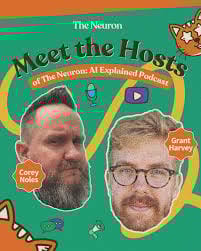
Last thing: And if you haven’t subscribed yet, please do! Click the image below to go to our channel and hit “subscribe” to get notified right when new videos go live.

We have a goal to hit 50K subscribers by the end of the year (if not 100K), and we’re only ~30K away! If you like learning about AI, and already watch some of our videos, do us a favor and click here to subscribe today.
Stay curious,
The Neuron Team
 | That’s all for today, for more AI treats, check out our website.
|

P.P.S: Love the newsletter, but don’t want to receive these podcast announcement emails? Don’t unsubscribe — adjust your preferences to opt out of them here instead.