- The Neuron
- Posts
- 😸 WATCH: Sleeping on Microsoft AI? Whoops.
😸 WATCH: Sleeping on Microsoft AI? Whoops.
Microsoft Build sit-down with Mustafa Suleyman on Microsoft’s 7-model AI flex


Corey Noles & Matthew Robinson
June 10, 2026

Click the image to go straight to YouTube! This is the most information dense 15 min interview we’ve ever done; def worth the time!

Welcome, humans.
Microsoft just dropped seven new AI models in one day. SEVEN. 🫨
That includes models for transcription, voice, images, code, and reasoning, the AI equivalent of walking into Build with a Costco variety pack and saying, “Yes, all of these are ours now.”
But the bigger story isn’t just the model count.
Microsoft AI CEO Mustafa Suleyman says the company is trying to become truly self-sufficient in AI. Translation: Microsoft still loves OpenAI, but it would also very much like its own keys to the spaceship.
So what does that mean for Copilot, developers, healthcare, and Microsoft’s bigger bet on “humanistic superintelligence”?
In our latest podcast episode, Corey sits down with Mustafa Suleyman at Microsoft Build 2026 in San Francisco to talk through exactly that question: why is it so important for humans to “remain in control” of AI development?

Click the image to watch on YouTube
Keep scrolling for our favorite moments from the episode and why you should watch.

THIS EPISODE WAS BROUGHT TO YOU BY…
Free Identity Security Risk Assessment: Find Hidden Threats Fast with BeyondTrust

Identity security risks are often hidden deep within your environment, and this free assessment helps uncover dangerous privilege exposure, identity attack paths, and security gaps fast.
Identity is today’s biggest attack surface and it’s growing fast. From humans to machines to AI agents, hidden risks are everywhere. BeyondTrust’s free Identity Security Risk Assessment quickly uncovers excessive privileges, toxic access, and attack paths so you can fix risk before attackers find it. Get clear visibility across cloud, SaaS, and hybrid environments. Start your free assessment today.

Our favorite moments:
(1:01) Seven models in one day: Microsoft’s new AI lineup across transcription, voice, image, code, and reasoning.
(2:12) The OpenAI shift: Why Microsoft wants to be “truly self-sufficient” in frontier AI while still partnering with OpenAI.
(2:55) MAI-Thinking-1: Microsoft’s first reasoning model, and why Suleyman says it was built differently from consumer-focused models.
(5:04) The specs: 35 billion active parameters, a 256K context window, and a 109-page technical report. Casual light reading.
(5:50) The data mountain: Why Microsoft starts with more than 250 trillion tokens, then whittles that down to train the model efficiently.
(6:40) The superintelligence building blocks: How voice, vision, reasoning, and code all fit into Microsoft’s bigger AI roadmap.
(8:13) Humanistic superintelligence: Mustafa’s test for whether technology should exist at all: does it accelerate human progress?
(10:20) The Mayo Clinic partnership: Why Microsoft is training a new health foundation model from scratch with one of the world’s top medical institutions.
(12:45) The healthcare unlock: Why Suleyman thinks AI-assisted clinicians could be the next major wave after chatbots and coding agents.
Bottom line: Microsoft isn’t just stuffing AI into Office anymore. It’s trying to own more of the AI stack, from models to products to healthcare, and Suleyman’s pitch is that the whole thing should pass one test: does this actually help humans?
Watch/Listen now on YouTube | Spotify | Apple Podcasts
P.S. Corey called it “watching something be built in public,” which feels right. Microsoft is basically assembling the AI Avengers, except instead of capes, everyone gets a 109-page technical report. 🖥️
P.P.S. This isn’t Mustafa’s first appearance on The Neuron AI Explained. If you enjoy this interview, go check out our previous deep discussion with Suleyman on AI consciousness.

🔴 TOMORROW: AI Skills vs Agents vs GPTs: Which One Do I Use? | Neuron LIVE
Thursday, June 11 at 10:00 AM PT / 12:00 PM CT / 1:00 PM ET

Click the image above to go to YouTube, then hit “Notify me” so you don’t miss it!
AI Skills. Projects. Gems. Custom GPTs. Agents.All useful. All confusing. All currently being shoved into product announcements like someone emptied an AI junk drawer onto your desk and said, “Good luck, champ.”
Tomorrow on Neuron LIVE, we’re breaking down what each one actually does, who should use it, and how to decide which one fits the workflow you’re trying to build.
We’ll cover:
Projects: Places to organize ongoing work (but much more than that).
Gems & Custom GPTs: Reusable custom assistants.
Skills: Repeatable instructions and workflows you can deploy anywhere.
Agents: AI systems that can take actions on your behalf.
Plugins: Oh yeah, what the heck are these?! Now we have these too??
If we have time, maybe we’ll even touch on “loops”, the trendiest topic in AI discourse right now… (or you can read this article all about that).
The goal is simple: by the end, you should know when to organize work, when to customize an assistant, when to save a reusable skill, and when to let an agent actually go do something.
This is basically the guide we wish existed when all these new form factors came out in the first place. Take notes, AI labs (or send us your best explainer videos that we apparently totally missed to reshare…).
Click here to bookmark the link to watch live:
🎙️ In Case You Missed It…
Four recent interviews you’ll definitely want to check out (pick whatever looks interesting to you and dive in!):
1. Want to know who’s real online anymore? Watch: Tiago Sada Explains Why the Internet Needs Proof of Human

Corey sat down with Tiago Sada, Chief Product Officer at Tools for Humanity, for a very timely conversation about one of the internet’s fastest-growing problems: proving there’s an actual human on the other side of the screen.
Tools for Humanity is building the technology behind World and World ID, a system designed to verify that someone is a real, unique person without making them hand over their full identity to every app, website, ticketing platform, dating app, or suspicious “free iPad” pop-up they encounter online.
TL;DW: Corey and Tiago dug into why CAPTCHAs, KYC checks, and AI detection are starting to crack under the pressure of bots, deepfakes, and AI agents. They also covered how World ID works, what it stores, what it deletes, and why “proof of human” could become a trust layer for the internet.
Why you should watch: The biggest unlock here is not just stopping bots from hoarding concert tickets like tiny digital goblins. It’s the bigger question: how do we let AI agents act on our behalf without letting fake humans, fake accounts, and fake identities wreck the internet in the process?
P.S. This gets surprisingly practical fast. Dating apps, Zoom calls, gaming, Shopify stores, ticketing, enterprise security,basically anywhere you currently wonder, “Is this person real?” World ID wants to be part of the answer.
YouTube: Watch Here
Spotify: Watch here
Apple podcasts: Listen here
2. Want to build useful software with AI? Watch: Scott Hanselman Showcases Engineering with AI LIVE from Microsoft Build 2026

Live from Microsoft Build, Corey sat down with Scott Hanselman for one of our most useful beginner-friendly demos yet.
Scott is one of the best technical explainers in software: a longtime Microsoft and GitHub developer, teacher, speaker, author, blogger, and podcaster who has helped millions of people understand new tech without making them feel like they missed a prerequisite course in 2007.
TL;DW: Corey and Scott walked through what AI-augmented software development looks like beyond “vibe coding,” including GitHub Copilot, practical prototyping, small tools, and how to turn everyday ideas into working software. Scott also showed his own vibe-coded projects, including Baby Smash and Tiny Tool Town.
Why you should watch: The coolest demo was Scott taking an open-source tool and turning it into a personal blood sugar tracking app for his own diabetes management. If that does not get your idea blood flowing for what you can build with AI, we do not know what will.
P.S: We just turned this livestream into a blog recapping what Corey and Scott discussed, trying to make sense of it for beginners. Read it here to follow along.
YouTube: Watch Here
3. Wondering what comes after GPUs? Watch: What Comes After GPUs? Great Sky’s Bet on Brain-Like AI

TL;DW: Corey talked with Jeff Shainline, co-founder and CEO of Great Sky, about superconducting optoelectronic networks, brain-like AI hardware, and why future AI systems may need machines built around memory, light, and analog values instead of today’s GPU-heavy stack.
Why you should watch: This is the hardware version of the post-transformer debate. If AI progress depends on which architectures our machines can cheaply test, Great Sky’s bet could make weirder model ideas much more practical.
YouTube: Watch Here
Spotify: Listen Here
Apple Podcasts: Listen Here
4. Want to build real-time voice agents? Watch: Building AI Voice Agents with LiveKit’s Ben Cherry

TL;DW: Corey went live with Ben Cherry from LiveKit to break down real-time AI agents that can listen, respond, handle interruptions, use tools, and feel fast enough for actual humans.
Why you should watch: Voice agents sound easy until latency, interruptions, audio quality, and turn-taking show up. This one is useful if you want to understand what separates a neat demo from something people can actually use.
YouTube: Watch Here

One more before you go:
We’ve been doing a run of beginner-friendly livestreams lately. Here’s our rec: start with A Total Beginner’s Guide to AI Agents & Automation if you want the plain-English version of agents, automation, APIs, webhooks, JSON, and MCP. We’ve got a written guide to accompany it here as well.
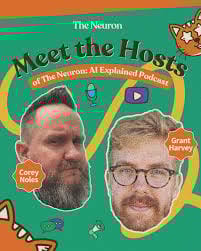
Last thing: And if you haven’t subscribed yet, please do! Click the image below to go to our channel and hit “subscribe” to get notified right when new videos go live.

We just crossed 20K subscribers (30,000 across platforms), which is awesome. Now we’re trying to hit 50K by the end of the year.
We’re actually at 20.5K right now… But wouldn’t it be cool if you helped us go from 20.5K… to 25K?!
Well, you can! If you like learning about AI, trust, agents, and what all this means for normal humans trying to keep up, do us a favor and click here to subscribe.
Stay curious,
The Neuron Team

 |
|