- The Neuron
- Posts
- 😺 🎙️ Watch: NVIDIA's 120B Model Runs Like a 12B. Here's How.
😺 🎙️ Watch: NVIDIA's 120B Model Runs Like a 12B. Here's How.
PLUS: In 1 hour, we're talking GTC LIVE at GTC!

Matthew Robinson
March 19, 2026

Click the image to watch this new interview!
Welcome, humans.
Corey has been live at NVIDIA GTC 2026 this week and it has been a ride. We’ve heard this event described as a Taylor Swift concert for nerds, and we HARD agree.
Anyway, he’s been on the ground in San Jose all week talking to the people building the next generation of AI infrastructure… and he’s got A LOT to share.
First up: We just published our new interview with NVIDIA's VP of Generative AI, and we're going live in about an hour to break down everything Corey’s seen and heard from the exclusive events and showroom floor.
Plus, we’ll chat all the reveals from Jensen’s keynote, including the seven new chips, five new rack types, an agentic AI operating system, and of course that $1 trillion demand forecast.

Click the image to watch on YT; it’s 5pm PT | 7pm CT | 8pm ET
We also just published Corey's write-up of the Open Model Super Panel, moderated by Jensen, featuring Perplexity's Aravind Srinivas, LangChain's Harrison Chase, Thinky’s Mira Murati, and Cursor's Michael Truell. That one's worth a read on its own (more on that below).
Let's dive deeper into all of the above, shall we??
First off, NVIDIA just built a 120 billion parameter AI model runs as fast as a 12 billion parameter one—and they're giving it away for free.
If you don’t know, parameters are essentially the knobs an AI tunes during training to learn patterns in language, code, and knowledge, that turns into a bunch of numbers that determine how it responds to you or does things; more parameters generally means a smarter model.
That means you can run a model nearly twice the size of Meta's Llama 70B on a home GPU (the graphics chip in your computer that handles heavy AI processing), at 3x the speed. No data center required. Corey tested it himself on an RTX 4000. It was good! you can thank mixture of experts for that.
Also, worth noting: There’s also a nano version (check it out via this demo)! That’s usually a good indication you could run it on a computer with less memory.
Here’s how to run it (if you’re technical) and if you’re not, try it out in LM Studio (or if you’re a clawaholic, you can ask your Claw to do it; more on that in a sec)!
Now, Nemotron 3 is built to be the default brain behind NemoClaw—NVIDIA's new open-source runtime (think of it as a secure operating environment) for running secure, always-on OpenClaw AI agents on your own hardware (try it here).
An AI agent, if you're not familiar, is an AI that doesn't just answer questions (like ChatGPT), but it can actually take actions on your behalf, like sending emails, managing files, or calling other tools. OpenClaw is the one that’s become more popular than Linux, and NVIDIA CEO Jensen Huang basically said if your company doesn’t have an OpenClaw strategy, you’re cooked. Or should we say boiled, à la un claw? 🦞
In our latest podcast episode, Corey sat down with Kari Briski, NVIDIA's VP of Generative AI for Enterprise, live at GTC 2026 to break down how they pulled all this off… and where all of this is heading:
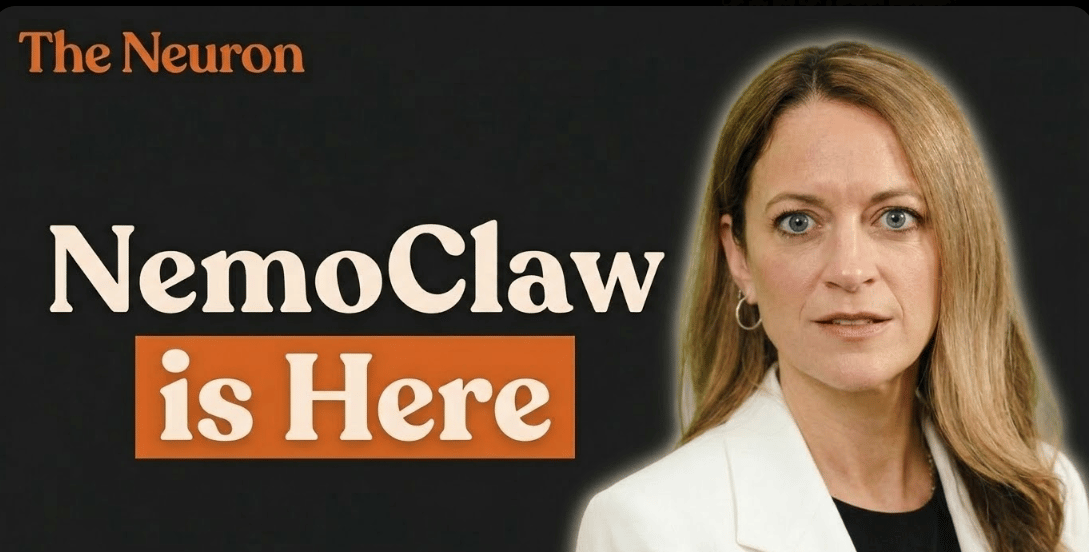
Click the image above to watch on YouTube!
Some of our favorite parts:
(1:45) What Nemotron 3 Super actually is, and why NVIDIA published their entire model roadmap.
(7:26) The home GPU reality check: Corey's running 120B parameters on an RTX 4000 at triple the speed of a 70B model.
(8:09) Why 120 billion parameters only activates 12 billion at a time—and what that means for your hardware.
(13:38) The wildest AI agent story yet: an NVIDIA dev's AI caught a water leak, texted him, and emailed a plumber.
(17:34) Open-source AI token generation exploded 35x in one year—here's what's driving it.
(20:49) Kari's long-term vision: Nemotron as a software development library, not just a model.
Bottom line: NVIDIA is treating open-source AI like infrastructure—not a side project. If you want frontier-level AI that you can actually control, fine-tune, and run locally, this is the roadmap to watch.
Listen now on YouTube | Spotify | Apple Podcasts
P.S. If you only have 90 seconds, jump straight to the water leak story at (13:38). It's the most convincing AI agent demo we've seen—and it happened by accident. 🔧Real quick: Want to see your AI-adjacent product or service show up right here, below these podcast promos? Click the button below to advertise to our 650K readers!

A few insights from the Open Model Super Panel: 3 things that stuck with us
Corey's full write-up is here, but if you only have 30 seconds, check this out:
"Harness engineering" is the new term to know. LangChain's Harrison Chase coined it to describe everything wrapped around a model—sub-agents, memory, tools, policy. His argument: when you're impressed by an AI product, you're usually responding to the harness, not the model. Or both, if using Claude Code / Codex.
Perplexity is building an AI computer, not a chatbot. Aravind Srinivas described "Perplexity Computer" as a system that takes your task and figures out which models, tools, and workflows to use. You stop picking models. The computer picks for you.
The debate is shifting from models to systems. Open models are becoming raw material. Open agents are becoming the interface. And the harness is where trust, customization, and product value get built. As Jensen put it: "Proprietary versus open is not a thing. It's proprietary AND open."
On that last point: So maybe Anthropic and OpenAI will soon realize they’re actually harness companies, and not just model companies?? Man, what we wouldn’t give for an Open Claude…
Dive deeper with all our NVIDIA GTC 2026 coverage:
And if you haven’t subscribed yet, please do! Click the image below to go to our channel and hit “subscribe” to get notified right when new videos go live.

We have a goal to hit 50K subscribers by the end of the year (if not 100K), and we’re closing in on 20K! If you like learning about AI, and already watch some of our videos, do us a favor and click here to subscribe today.
Dive deeper with these resources:
NemoClaw on GitHub — secure, sandboxed runtime for OpenClaw agents
NemoClaw install guide — one command to get started
Stay curious,
The Neuron Team
 | That’s all for today, for more AI treats, check out our website.
|

P.P.S: Love the newsletter, but don’t want to receive these podcast announcement emails? Don’t unsubscribe — adjust your preferences to opt out of them here instead.