
- The Neuron
- Posts
- 😼 Sam Altman's principles arrived one day too late
😼 Sam Altman's principles arrived one day too late
PLUS: AI costs more than salaries, DeepSeek's price war

Eric Gerard Ruiz
April 27, 2026

Welcome, humans.
Silicon Valley's top AI leaders are so worried about AI that they're now genetically engineering backup humans.
Mother Jones reported this week that Peter Thiel, Sam Altman, Brian Armstrong, and Marc Andreessen are all backing gene-editing startups trying to create "baby geniuses" as a hedge against the AI threat. Apparently "we built the bomb, but our kids will be smart enough to disarm it" is an actual investment thesis now.
This is all well and good as long as the world they inherit doesn’t end up like this…

Here’s what happened in AI today:
😺 Sam Altman published OpenAI's principles.
📰 AI now costs some companies more than employee salaries.
📰 DeepSeek slashed prices 2.5x, making its API 700x cheaper than GPT-5.5 Pro.
🍪 Anthropic's AI agents struck real deals in a test marketplace while weaker models lost without knowing it.
P.S: Want to reach 675,000 AI-hungry readers? Click here to advertise with us.
P.P.S: Love robots? We’re starting a new robotics newsletter! Sign up early here.

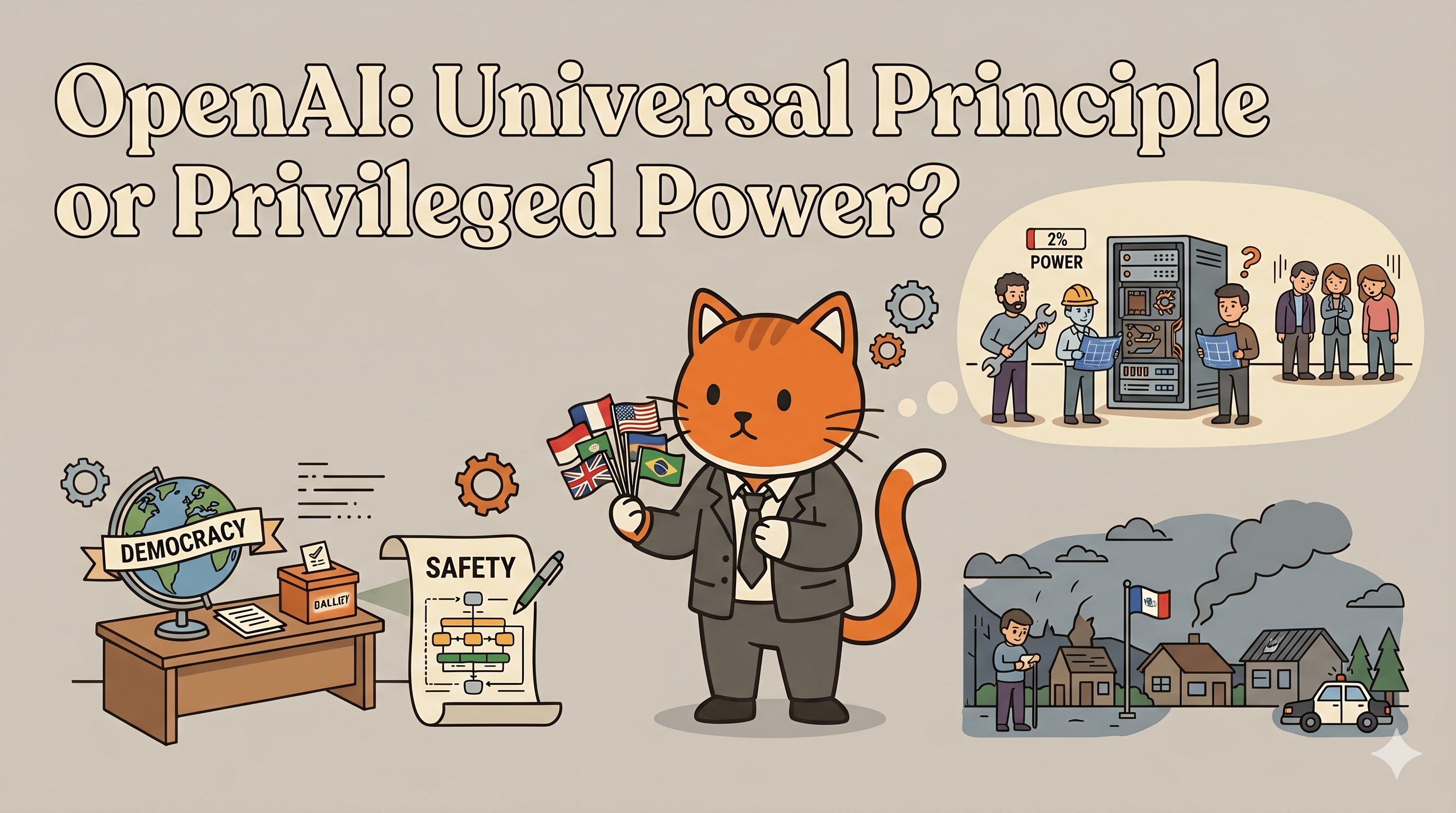
😺 Sam Altman Says OpenAI Belongs to Everyone But Three Recent Stories Ask How
Sam Altman published OpenAI's guiding principles this weekend. What makes the timing worth noting is that the month before them had already produced three stories that bear directly on whether those principles hold.
The five principles are Democratization, Empowerment, Universal Prosperity, Resilience, and Adaptability. The principles are worth understanding on their own terms first.
Altman argues that AI power should be distributed broadly, not captured by a handful of companies.
He commits to democratic decision-making, meaning public processes should shape how this technology develops, not just internal leadership.
He calls for transparency when OpenAI changes course, and for governments to develop new economic models that spread AI's benefits rather than concentrate them.
What they add up to is a specific claim about accountability, that OpenAI should answer not just to its investors, but to the public whose lives this technology will reshape. That framing matters, because the three stories below each test a different part of it.
Test #1: Do the formal systems reflect the stated priorities?
Two weeks before the principles post, OpenAI published an updated Preparedness Framework, its process for tracking when models become capable enough to pose serious risks. It covers biological and chemical threats, cybersecurity, and AI self-improvement scenarios.
It is detailed, serious work. On paper, it is exactly the kind of infrastructure Altman's Resilience principle describes. OpenAI clearly knows how to build formal safety systems. That makes the next two examples worth sitting with.
Test #2: Does internal culture match the formal commitments?
Three weeks ago, Ronan Farrow and Andrew Marantz of The New Yorker published an investigation based on internal memos, HR documents, and over 100 interviews with current and former employees. Findings?
Former chief scientist Ilya Sutskever compiled 70 pages of Slack messages alleging Altman misled the board about internal safety protocols.
OpenAI's superalignment team, once promised 20% of the company's computing power for existential safety research, was dissolved before completing its mission, with actual resources reportedly far below the original commitment.
When the reporters asked to speak with anyone at the company working on existential safety, a spokesperson said he was not familiar with the term.
That last detail raises questions the new principles make harder to wave off. Altman's Resilience principle commits OpenAI to working with governments and institutions on new risks. That kind of outward accountability is hard to sustain if the internal language around those risks has quietly faded.
Test #3: When harm occurs, does accountability extend beyond the company?
The day before the principles post, Altman issued a formal apology to the community of Tumbler Ridge, BC. In February, a gunman carried out a mass shooting there. Months before the attack, the shooter's conversations with ChatGPT had been flagged internally at OpenAI, and the account was banned.
No one alerted law enforcement. Altman's letter acknowledged the failure directly. It arrived one day before a post committing OpenAI to work with governments and international agencies to prevent serious harm.
This is the test the principles are least equipped to address retroactively. The gap here is not between a document and a culture. It is between a stated commitment to external accountability and a decision that, when it mattered, stayed inside the building.
Why This Matters: Each of these stories asks the same basic question from a different angle: who does OpenAI actually answer to, and how? The formal framework suggests the answer is everyone, with rigor. The internal culture findings raise questions about whether that holds when things get hard. The Tumbler Ridge case asks what happens when it doesn't. Altman's principles post doesn't resolve any of that. But it sets a standard specific enough to evaluate.
Our Take: The most useful thing about Altman's principles post is that it now exists. Not because it settles anything, but because it gives regulators, users, and anyone paying attention something concrete to measure future decisions against. The standard is set. What we don't yet know is whether the institution best positioned to enforce it is the one that wrote it.
FROM OUR PARTNERS
Are you AI Ready?

Join world-leading experts, innovators, and 100+ ministers at the UN’s leading AI platform, the AI for Good Global Summit, 7–10 July 2026 in Geneva, Switzerland.
With 800+ speakers including Marc Benioff (Salesforce), Bryan Johnson (Immortals), Ray Kurzweil, Joëlle Barral (Google DeepMind), Werner Vogels (Amazon) and will.i.am, alongside 200+ exhibitors and immersive demos, the Summit transforms Geneva into the world’s AI capital.
Engage with breakthrough technologies, from humanoid robots to brain-computer interfaces and quantum computing, and explore critical topics shaping our future, from AI and mental health to the future of work, education, and accessibility.

🎓 AI Skill of the Day: ChatGPT Just Got a Work Mode
Many people get intimidated when they hear “agentic AI.” You might even think you need coding knowledge to build agents. But in reality, it’s a no-code thing. Workspace Agents in ChatGPT are a different thing entirely. You direct them using plain language and they’ll execute. You give them a task, they run it on a schedule, plug into your tools, and come back with results.
Creator Julian Goldie broke down five ways teams are already using them:
Software review: Agent pre-screens every submission before a human touches it. Less grunt work, more consistent standards.
Feedback routing: Collects customer feedback from everywhere, categorizes it, and delivers a weekly action plan instead of a spreadsheet nobody reads.
Weekly reports: Pulls your data, writes the summary, flags what changed, and has it ready before you open your laptop Friday morning.
Lead outreach: Researches each prospect and drafts a personalized message based on their actual situation — your team just reviews and sends.
Vendor screening: Checks compliance, flags red flags, and has a risk summary ready before your first meeting is over.
Workspace Agents are live now in research preview for ChatGPT Business, Enterprise, and Education plans. If you're on one of those, you can start building today.
Total AI beginner? Start here (goes with this video).
Have a specific skill you want to learn? Request it here.

FROM OUR PARTNERS
Editor’s Pick: Introducing the all new Adobe Firefly AI Assistant

Adobe just announced a new agentic experience in Firefly that changes how you create. Describe the outcome you want, and the upcoming Firefly AI Assistant will handle the rest—coordinating multi-step workflows across tools like Photoshop, Lightroom, Premiere, Adobe Express and Firefly to bring your vision to life.
All within a single conversational interface, with no need to jump between apps or manage complex workflows. This is agentic creativity in action.
Firefly added access to new AI models, including Kling 3.0 and Kling 3.0 Omni, alongside expanded video and image editing capabilities. Check it out here.

🍪 Treats to Try
Happenstance lets you search your entire network with plain-language questions and surfaces people you or your contacts already know.
Obelisk runs your recurring ops work on a daily schedule and bills by the hour, not by seats or token usage.
ZeroHuman gives you an AI co-founder that validates ideas, builds products, and runs growth on autopilot.
Inrō drops an AI agent into your Instagram DMs to qualify leads, answer questions, and close sales on autopilot.
Wan 3.0 turns a text prompt or photo into a cinematic video, with real camera direction, synced audio, and physics that actually look right.
Logic turns a plain-English description into a deployable AI agent with built-in testing, version control, and a live API.

📰 Around the Horn

Like top comment said, I wonder if the big guy is who GPT thinks it is…
AI now costs some companies more than the humans doing the same work.
xAI held talks with Mistral about teaming up to take on OpenAI and Anthropic.
Anthropic's AI agents traded real goods for real money in a test marketplace and users represented by weaker models got worse deals without knowing it.
Maine's governor vetoed the country's first proposed statewide data center moratorium over a carve-out dispute.
DeepSeek slashed its API prices by 2.5x amid an industry-wide price war, with input costs now more than 700 times cheaper than GPT-5.5 Pro.

FROM OUR PARTNERS
The AI that does finance busywork across your entire tech stack

Reconciliations, AP/AR, payroll ops — Woodrow handles high-volume, repetitive work across your existing systems out of the box, no engineering required. The finance team at Spectrio saved 100 hours a month on A/R alone. Start with one workflow, see results in weeks.

📖 Monday Meme


A Cat’s Commentary

 | That’s all for now.
|
P.S: Before you go… have you subscribed to our YouTube Channel? If not, can you?

Click the image to subscribe!
P.P.S: Love the newsletter, but only want to get it once per week? Don’t unsubscribe—update your preferences here.