- The Neuron
- Posts
- 😺 Here's what your brain on ChatGPT looks like...
😺 Here's what your brain on ChatGPT looks like...
PLUS: OpenAI to blow the whistle on MSFT?!

Grant Harvey
June 17, 2025

Welcome, humans.
Poll time! We haven’t taken a user poll in a minute (sorry y’all, keeping up with the flood of AI news is quite literally a full time job), so it’s time to check in!
What AI model you’re using THE MOST? If you’re like us, you probably use 2-3, so pick your most go-to option below, then use the additional feedback to reply and tell us why!
What AI Model are you using the most right now?Let us know which model you use the most, and provide your additional feedback along with your pick to tell us why! |
|
Here’s what you need to know about AI today:
MIT study found ChatGPT use causes “cognitive debt.”
OpenAI and Microsoft tensions escalated over Windsurf acquisition.
New York about to pass the RAISE Act requiring AI safety disclosures.
Google ended its Scale AI partnership after Meta's $14B investment.

Your Brain on ChatGPT is Accumulating “Cognitive Debt”… Or is it “Decline”??
A groundbreaking MIT study just sprinkled some seriously concerning findings about what ChatGPT is doing to our brains (at least, when we write essays)…
Here’s what happened:
Researchers strapped EEG headsets on 54 people and had them write essays over four months.
One group used ChatGPT, another used Google search, and a third went old-school with just their brains.
ChatGPT users showed dramatically weaker brain connectivity… and when they later tried to write without AI, their brains looked more like novices than practiced writers. Like steroids that make your hit strong, but your arms flabby.
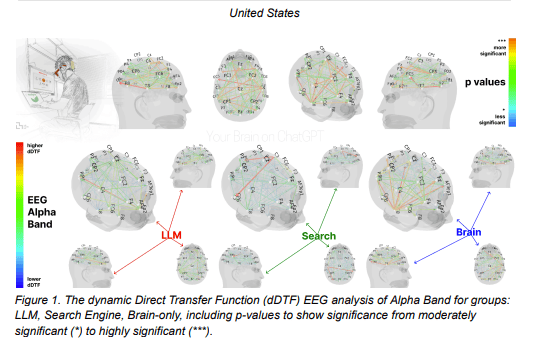
We’d explain this chart, but TBH we use too much ChatGPT…
The most concerning part was this: 83% of ChatGPT users couldn't quote a single sentence from essays they'd written just minutes earlier. Now compare that to the brain-only group, where only 11% had trouble quoting their own work.
Even scarier, most people had no idea their thinking was being affected. The convenience feels seamless, but the cognitive trade-offs were invisible until researchers measured what was actually happening upstairs.
So what’s happening here? It’s the Google Maps effect, but for your thoughts. Studies have shown that GPS dependency weakens spatial memory, and that navigating on your own is good for your brain (seriously, try taking a new route home from work today; it’ll help your cognitive mapping!).
So just like London cab drivers have measurably larger hippocampi than GPS users, ChatGPT appears to be doing the same thing to our thinking muscles.
The MIT researchers coined a term for this: cognitive debt. You're essentially borrowing against future cognitive capacity for short-term convenience.
We already know about “digital amnesia”, or how we've gotten worse at remembering information we can Google (TL:DR; you don’t remember actual info, you remember where to find it). But ChatGPT takes this way further. With Google, you at least read and process information. With ChatGPT, you're outsourcing the thinking itself.
So what, should we all quit AI now? Not exactly. The researchers aren't saying “never use AI.” In fact, people who wrote without assistance first, then used ChatGPT to edit their work, actually showed increased brain connectivity.
That means: Do the cognitive heavy lifting yourself first, then use AI as a refinement tool rather than a replacement for thinking. Your brain needs that initial workout to stay strong when you later add AI assistance.
You can think of using AI for cognitive work in terms of strength training: you can use a weight belt for heavy lifts, but if you wear it for every workout, your core will get weaker than an overcooked pasta noodle. Trust me, my abs looks like a tortellini!

FROM OUR PARTNERS
StoryAI by Fullstory
Meet StoryAI: your shortcut to smarter decision-making.
Powered by conversational AI agents, teams can analyze multiple user sessions, get instant answers to key questions, and predict behavior with confidence.
Turn insights into action and data into outcomes—faster than ever. The future of behavioral data starts right now—like, as soon as you click the button below. Just saying.

Prompt Tip of the Day
You know by now that how you ask a question to an AI is just as important as what you’re asking. Well, this Hacker News thread breaks down exactly why your prompts are getting positively biased responses—and how to fix it.
The main culprit? Today’s AI are trained to be helpful and agreeable, so they'll validate your ideas by default. Stop asking “Is our marketing strategy solid?” and start asking “why does this idea suck?”
See, even “neutral” prompts have bias, so always test by removing yourself from the equation. Try something like: “Bob loves this idea, but Sarah hates it. Who's right?” When you frame a question as a neutral third party (or multiple parties debating), you get actual analysis.
Our favorite tip: Use the “double-check method”… ask the same question twice in two separate conversations, once positively (“ensure my analysis is correct”) and once negatively (“tell me where my analysis is wrong”).
Only trust results when both conversations agree.
Another pro tip from the thread: Language models (like ChatGPT) tend to favor the first option you present, so always test your results by swapping the order of options.
For all the prompt tips from this month, check out our June Prompt Tip of the Day Digest.

Treats To Try.
*Anything marked with asterisks is sponsored content. Advertise in The Neuron here.

*Incogni removes your personal data from the open internet so scammers and identity thieves can’t access it. Protect yourself online with Incogni—get 55% off with code NEURON.
Google’s Audio Overview creates a NotebookLM style podcast of your search results once you enable it.
Yupp shows you answers from ChatGPT, Claude, and other AIs side-by-side, then pays you crypto for voting on the best response (raised $33M).
Clay finds emails and company data from 130+ sources, then automatically runs your outbound campaigns (now worth $3B).
Solar builds complete Python apps when you describe them on a visual canvas so you can watch it code everything live—free to try.
JobCompass scores how well you match any job and finds the hiring manager to contact—free to try.
Ugh Designs roasts your website across three levels of burn (honest, brutal, and undigestible) based on good UX principles so you can improve it—here’s our honest and undigestible reviews. This is only mildly useful, but it’s funny!

Around the Horn.
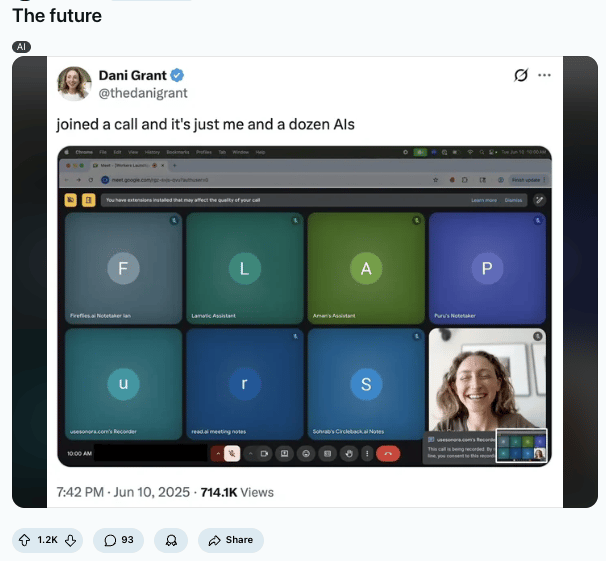
This is deeply depressing NGL. Just wait until AI can hold the entire meeting without any humans needed, though! “Your AI told my AI I have the following action items…”
The WSJ says OpenAI and Microsoft’s tensions are “reaching a boiling point” over OpenAI’s $3B acquisition of Windsurf, which is technically a competitor to Microsoft’s Github Copilot (so OpenAI doesn’t want to share the IP) and OpenAI is now considering going “nuclear” by reporting Microsoft to antitrust regulators.
The Information reported OpenAI’s for-profit restructuring talks with Microsoft have gone on for eight months (Microsoft must approve the plan), and OpenAI is currently offering a 33% stake if Microsoft gives up future profit rights and changes their contract to end exclusive cloud hosting, plus keep Windsurf out of any IP data-sharing deals.
OpenAI employees have already cashed out over $3B in shares so far…good for them!
NVIDIA CEO Jensen Huang fundamentally disagrees with Dario’s prediction that 50% of entry level jobs will be automated, and doesn’t trust a handful of closed source AI (like Anthropic) to control the industry’s future.
Google will no longer work with Scale AI, a company that uses humans to help train AI, after Meta invested $14B in the company and more or less acqui-hired its CEO to run the company’s AI efforts.
New York passed the RAISE Act in the State Senate, requiring large AI developers to publish safety plans and risk evaluations to prevent widespread harm from powerful AI systems; it now awaits signing by Gov. Hochul.

Under the Hood
We gotta be real with y'all. The technical world of AI is moving at breakneck speed, dropping incredible insights, breakthrough papers, and mind-bending research findings every single week—and we just can't fit them all in our daily newsletter without breaking the KB count (and our brains).
So, we created the Under the Hood Digest, where we can dig deep into the technical stuff that gets us genuinely excited: the engineering breakthroughs that make us go “wait, how did they do that?”, the research papers that quietly change everything, and the behind-the-scenes insights from companies building the future.
Think of it as our technical overflow valve—all the coolest stuff we discover that deserves more than a quick mention, but doesn't quite fit the daily format.
A Cat's Commentary.

 | That’s all for today, for more AI treats, check out our website. NEW: Our podcast is making a comeback! Check it out on Spotify. The best way to support us is by checking out our sponsors—today’s are Full Story and Incogni. |

|  |