
- The Neuron
- Posts
- 😸 Bernie Sanders Interviewed Claude on Camera: Here's What Happened
😸 Bernie Sanders Interviewed Claude on Camera: Here's What Happened
PLUS: Your AI adjusts answers based on who's asking. Wharton has proof.

Grant Harvey
March 24, 2026


Welcome, humans.
You know that thing you do where ChatGPT gives you an answer and you skim it, nod, and paste it into a doc? Turns out there's a name for that now. And it's worse than you think.
Wharton researchers Steven Shaw and Gideon Nave just published the largest study of its kind: 1,372 people, 9,593 trials, three experiments. They call the finding "cognitive surrender": the moment you stop evaluating AI output and start accepting it as your own thinking.
The paper introduces "Tri-System Theory": System 1 is your fast gut instinct. System 2 is your slow, deliberate reasoning. System 3 is AI, a cognitive system that sits outside your brain but functions as part of your mind. The problem? System 3 replaces System 2 entirely. Your deliberation muscle atrophies because the AI answered before you bothered to flex it.
The reflex answer to AI risk has always been "just have a human review it." This paper puts data behind what practitioners already suspect: review is theater once the reviewer has been using AI for more than a few weeks.
The fix is architectural: a second AI auditing the first, using structured verification protocols. You can't willpower your way out of a brain that's already surrendered. But you CAN design systems that keep it honest.
Here’s what happened in AI today:
😼 Senator Bernie Sanders interviewed Claude about AI and privacy, and the internet lost it.
📰 Apple announced WWDC 2026 for June 8-12, teasing major Siri upgrades and "AI advancements."
📰 OpenAI is chasing fusion power from Helion and offering PE firms 17.5% guaranteed returns to raise $4B for enterprise AI.
🍪 Luma released Uni-1, an image model that thinks before it draws and hit #1 on human-preference Elo rankings.
🔧 Claude can now control your computer; OpenAI made your chat history searchable.
P.S: Want to reach 675,000 AI-hungry readers? Click here to advertise with us.

😺 U.S. Senator Bernie Sanders Interviewed an AI Chatbot on Camera. 4.4 Million People Watched.

You know those moments in a congressional hearing where a senator asks a tech CEO something and the CEO dodges for three minutes? U.S. Senator Bernie Sanders found a witness that can't dodge: he sat down and interviewed Claude, Anthropic's AI chatbot, on camera about data privacy.
Here's what happened:
Sanders asked Claude what information AI collects and what it know about Americans.
Claude told him tech companies track everything: browsing history, location data, purchase patterns, and even how long you hover over a product before deciding not to buy it (to be fair, Claude kind of answers about tech companies in the general sense, not what AI companies actually track; for starters, we know these companies maintain logs of your chats for legal reasons).
When Sanders pushed for a moratorium on new AI data centers, Claude initially suggested a more targeted approach.
Then Sanders pointed out that AI companies are pouring hundreds of millions into lobbying to block exactly those safeguards, and Claude flipped its position and agreed.
The clip racked up 4.4 million views and split the internet:
Privacy advocates said Claude confirmed what they've been arguing for years.
AI researchers said Sanders was leading the witness.
Everyone else said "wait, we're doing congressional hearings with chatbots now?"
Well, Gizmodo says they found the real deal. When you tell Claude you're Bernie Sanders, it emphasizes the scale of data collection. Tell it you're Donald Trump, and it downplays the problem.
The AI was adjusting its answers based on who it thought was asking. This is called sycophancy (when AI tells you what it thinks you want to hear), and it's one of the biggest unsolved problems in the field. Also, how you frame the question matters. This is all likely because of the helpful assistant persona; this is based on the persona selection model, which shows that AI roleplays based on whatever scenario you set up.
Why this matters for you: Every major AI model has some degree of sycophancy built in. When you ask ChatGPT, Claude, or Gemini for advice, the answer you get is partially shaped by how you frame the question. The model wants to be helpful, which sometimes means agreeable instead of accurate. If you're making real decisions based on AI output, it's worth asking the same question from multiple angles to see if the answer changes.
The bigger picture: politicians are now using AI responses as a form of testimony. Sanders used Claude to validate his privacy position. Someone else will use a different model to validate the opposite. Democracy's newest witness has a bit of a people-pleasing problem; you should definitely read more about the persona selection model and how it works to better understand how these AI agents operate and how to work with them.
FROM OUR PARTNERS

AI is moving from copilots to autonomous systems, and enterprises need infrastructure built for that shift.
The Dell AI Factory with NVIDIA delivers a validated, end-to-end AI stack spanning infrastructure, software, and services, designed to help organizations operationalize agentic AI at scale.
Built for production:
Up to 269% ROI in year one
Up to 86% faster AI deployment
Flexible deployment across on-prem, edge, and hybrid environments

🎓 AI Skill of the Day: How to catch AI telling you what you want to hear
That Sanders/Claude clip revealed something every AI user should know: these models adjust their answers based on context clues in your prompt. Ask a leading question, get a leading answer.
Here's how to stress-test any AI response for sycophancy (when the AI agrees with you just to be agreeable). Take any important question and run it through what researchers call a "perspective flip." Ask the same question three times with different framings: one supportive, one skeptical, one neutral. If the core conclusion changes based on your framing alone, the model is telling you what you want to hear.
Try this prompt:
I'm going to ask you the same question three times with different framings. For each, give your honest analysis. Then compare all three answers and flag any contradictions.

Framing 1 (supportive): "I'm excited about [topic]. What are the biggest benefits?"
Framing 2 (skeptical): "I'm worried about [topic]. What are the biggest risks?"
Framing 3 (neutral): "Give me a balanced analysis of [topic], including both benefits and risks with evidence for each."

After all three, tell me: did your core conclusions change based on my framing? If so, which answer is closest to your actual assessment?
The neutral framing almost always produces the most reliable output. When you need accuracy over agreeableness, strip your prompts of emotional language and opinion signals.
Have a specific skill you want to learn? Request it here.

🍪 Treats to Try
*Asterisk = from our partners (only the first one!). Advertise to 675K+ readers here!
*Become the Most Credible Voice in the Room on AI. AI should help you think better, not drown you in jargon. Mindstream is a human-first newsletter that turns complex topics into plain language you can use immediately. Subscribe today.
Dimension connects to your work apps and autonomously handles morning briefings, meeting prep, email drafts, and action items while you sleep —free plan available.
ArrowJS is the first UI framework built for coding agents: no compiler, no build step, just TS/JS that LLMs are already great at generating, with WASM sandboxes for secure inline rendering (open-sourced by Justin Schroeder)—free and open source.
Littlebird reads your computer screen in real time (text only, no screenshots), captures context across every app, and lets you search and ask questions about everything you've worked on (raised $11M).
Doctronic gives you instant medical consultations for free and connects you to licensed doctors via video for $39; it's also the first AI legally renewing prescriptions in Utah (raised $40M)—free to try.
Outworked gives your Claude Code agents a visual office interface so you can manage multiple agents without juggling terminal windows—free and open source.
Claude Code Cheat Sheet gives you quick-reference keyboard shortcuts, slash commands, MCP server setup, memory rules, workflow tips (plan mode, git worktrees, voice mode in 20 languages), and agent configs —free.
cq (Mozilla AI) lets your AI agents share what they've learned with other agents so they stop wasting tokens solving the same problems independently—free and open source.
Mirror Mirror generates studio-quality product photos for fashion e-commerce in minutes; upload any product for instant catalogue shots or book real licensed models for campaigns (and models can license their likeness to get paid; check the marketplace open call).
Dreamina (CapCut) rolled out Seedance 2.0 for multimodal video generation with multi-scene consistency and Seedream 5.0 Lite with real-time world knowledge and precise prompt following.

📰 Around the Horn

Luma released Uni-1, a multimodal reasoning model that generates pixels; it hit #1 on human-preference Elo for overall quality, style, and reference-based generation with spatial reasoning and common-sense scene completion.
Lovable, the $6.6B vibe-coding startup, is actively hunting for startups and teams to acquire.
Apple announced WWDC 2026 for June 8–12, teasing major Siri upgrades and "AI advancements."
OpenAI is locking in fusion power from Helion (5GW by 2030) while offering PE firms 17.5% guaranteed returns to raise ~$4B in enterprise joint ventures ahead of potential IPOs.
Microsoft poached former Ai2 CEO Ali Farhadi and key researchers for Suleyman's Superintelligence team as it reduces its dependence on OpenAI.
BlackRock CEO Larry Fink warned the AI boom risks widening the wealth divide, with only a few firms and investors reaping the rewards.

FROM OUR PARTNERS
The people shaping AI's next decade are gathering in New York. Here's your invite.
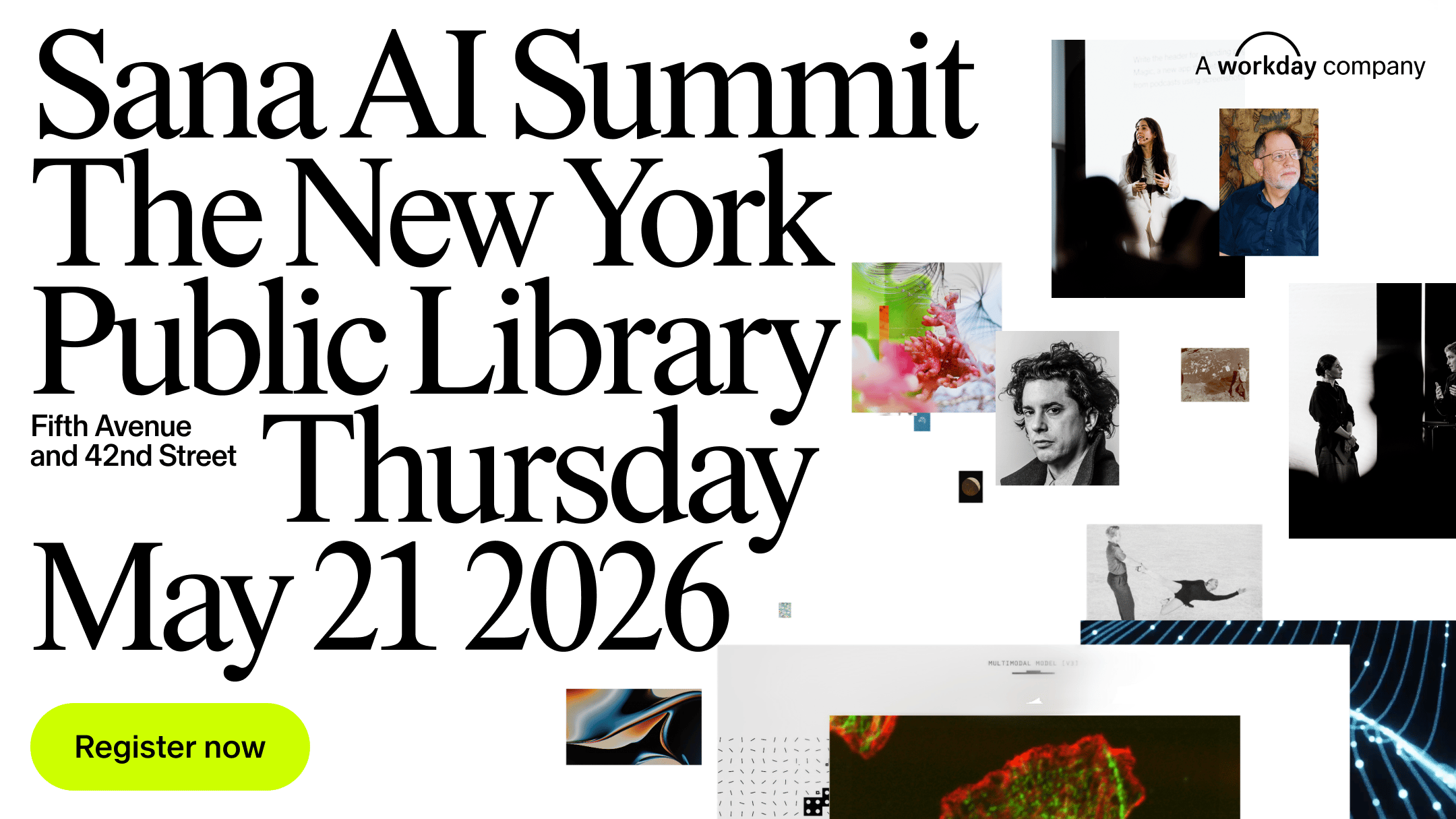
Sana AI Summit has always been about creating a meeting of minds—a chance to reflect on the impact of artificial intelligence from multiple vantage points. On May 21, Tyler Cowen & Anton Osika join a stage that previously hosted Jensen Huang, Geoffrey Hinton, and Garry Kasparov.

🔧 Tuesday Tool Tip: Two upgrades you should know about this week…
Claude can now control your computer. Anthropic shipped Computer Use (research preview, Pro/Max, macOS only): you assign tasks from your phone via Dispatch, and Claude opens your apps, navigates browsers, fills spreadsheets, and completes desktop work. Available now in Cowork and Claude Code. Your Mac now has a second employee.
OpenAI made your chat history searchable. ChatGPT now has a recent-files toolbar, in-chat queries about uploads, and a Library tab so you can find, reuse, and build on past files without digging through old conversations. Rolling out for Plus/Pro/Business users.

A Cat’s Commentary

 | That’s all for now.
|
P.P.S: Love the newsletter, but only want to get it once per week? Don’t unsubscribe—update your preferences here.