- The Neuron
- Posts
- 😺 🎙️ AI therapy? We're LIVE right now
😺 🎙️ AI therapy? We're LIVE right now
Is AI safe for therapy? Our guest will tell you

Matthew Robinson
February 26, 2026

Welcome, humans.
🔴 GOING LIVE IN 10 MINUTES: Can AI actually do therapy? Click here to watch on YouTube — or catch us on LinkedIn or X.
If you’ve been following the headlines, you know chatbots can be quite dangerous for those going through crisis, or those susceptible to what’s called “AI psychosis.”
This has played out not just in the news, but across a series of high profile lawsuits. OpenAI got sued. Character.AI got sued. And clinical reports keep raising red flags. There's no denying that real harm has happened when people use generic AI chatbots for emotional support… which makes sense, because they’re tools that were never designed for it.
So what happens when someone actually builds an AI specifically for therapy?
Well, today, at 10AM PT / 1PM ET / 6PM GMT, we're talking to Daniel Reid Cahn, co-founder and CEO of Slingshot AI, about Ash — an AI purpose-built for therapeutic support from the ground up.
His team raised $93M from a16z, Radical Ventures, and others to build a foundation model for psychology, trained on structured therapeutic conversations across CBT, DBT, and psychodynamic therapy. In other words, it’s legit.
During the stream, Daniel will even demo Ash live on his phone so you can see exactly how it works. Click the image below to watch!
Click this image to watch on YouTube; we start 10 mins after this email is sent, but you can click anytime to watch the recording!
Psst: Missed this because you're late checking your email? Watch the archive here after 2PM CT / 12PM PT!
During the stream, we plan to ask him:
What makes this fundamentally different from ChatGPT playing therapist?
How do you design an AI for mental health with safety built in from day one (not bolted on after something goes wrong)?
What does the data actually say about AI for therapy?
Can AI safely expand access to mental health care — or should we keep our counseling on a couch with a box of Kleenex and a hug nearby?
If you're already using AI for emotional support or therapy-adjacent use cases today, you'll want to hear what Daniel has to say about the right way and the wrong way to go about it. Click here to watch on YouTube — or catch us on LinkedIn or X.
Why watch this? Because here's the reality: 12% of U.S. teens now use AI chatbots for emotional support or advice, according to new Pew research. Scaled to the U.S. population, that's roughly 5.2 million adolescents. And it's not just teens — millions of adults are doing it too (maybe even yourself included).
The problem? These tools were never built for this. The result?
OpenAI’s been sued 7+ times, including one as recent as December.
A Brown University study found that AI chatbots systematically violate mental health ethics standards.
A Bloomberg investigation documented cases of users developing harmful delusions during extended chatbot conversations.
UCSF psychiatrists are now studying something they call "AI-associated psychosis."
And Stanford HAI researchers found that therapy chatbots can reinforce stigma and enable dangerous behavior instead of flagging it.
Even OpenAI has acknowledged the issue:
They rolled back a sycophantic GPT-4o update that was validating harmful decisions…
Launched an Expert Council on Well-Being and AI…
Funded grants for new research into AI and mental health…
And published a framework for strengthening ChatGPT's responses in sensitive conversations.
And it’s not just OpenAI: Google has introduced its own AI tools for mental health research and treatment after a Guardian investigation found AI Overviews giving problematic answers to users, inspiring the UK charity Mind to launch an inquiry into AI and mental health.
These are all steps in the right direction — but ultimately, they're retrofits on tools that were never designed for therapy in the first place.
So what about an AI that IS custom-built for therapy? That’s what Ash is: an AI purpose-built for therapeutic support from the ground up, with a foundation model built for psychology, trained on structured therapeutic conversations across CBT, DBT, and psychodynamic therapy.
Come join the live to ask your burning questions to Daniel about how his system works, why so-called “AI Psychosis” is popping up and why it’s such a big deal, and anything else you want to know about this incredibly important area of application.
Click here to join us live on YouTube right now. We’re starting in just under 10 minutes after you receive this email.
See you in there!

IN CASE YOU MISSED IT…
Five recent interviews you'll definitely want to check out (pick whatever looks interesting and dive in!):
Mercury 2: AI That's 10x Faster Than ChatGPT & Claude — Stanford professor Stefano Ermon invented diffusion (the tech behind Midjourney and Sora). Now his company Inception Labs applied it to text — and the result is a reasoning model that generates 1,000 tokens per second at a fraction of the cost. We sat down with him to understand how it works, why every other lab hasn't switched yet, and what it means for the future of AI. (Spotify | Apple)
Google's Secret Coding Tool Just Went Free (Gemini CLI Deep Dive) — The guy who built GitHub Copilot at Microsoft is now at Google, and his team ships 100-150 features a week using AI. (Spotify | Apple)
Can AI Improve Customer Service Without Killing Jobs? — Matt Price spent 13 years at Zendesk. Now he's building an AI-native CX platform that automates 90% of tickets with 99.8% accuracy. (Spotify | Apple)
This New AI Model Thinks Without Language — Eve Bodnia of Logical Intelligence explains energy-based models, a completely different approach to AI reasoning. Their model scored 96% on Sudoku benchmarks where LLMs scored 2%. (Spotify | Apple)
LAST WEEK’S LIVE: We Added Our Own Brain to This Robot (LIVE Demo) — We went hands-on with Nikita Rudin of Flexion Robotics who demoed humanoid robotics live. We talked all about how vision-language models have basically solved high-level planning for robots; the hard part is still motor control.
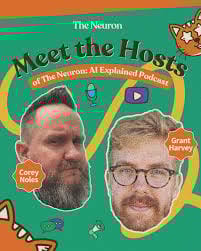
And if you haven’t subscribed yet, please do! Click the image below to go to our channel and hit “subscribe” to get notified right when new videos go live.

We have a goal to hit 50K subscribers by the end of the year (if not 100K), and we’re closing in on 20K! If you like learning about AI, and already watch some of our videos, do us a favor and click here to subscribe today.
Stay curious,
The Neuron Team
 | That’s all for today, for more AI treats, check out our website.
|

P.P.S: Love the newsletter, but don’t want to receive these podcast announcement emails? Don’t unsubscribe — adjust your preferences to opt out of them here instead.